The Eighth Continent is on fire!
From Min Barklin and the Silver Radants
Min stopped mid-sentence as a nightmare vision raced through her mind of gigantic flames ripping through the tops of trees.
She gripped Prini’s hand.
‘Prini, the canopies everywhere. The Eighth Continent, it’s on…’
‘What are you on about now?’ Galine interrupted.
‘The Eighth Continent. You know, the one where half of all the beings on the Great Orb live. It’s on fire. What’s happening to them?’ Min cried.
The Eighth Continent
In Min’s world, the Eighth Continent is the living roof of her species’ world—the woven web of forest canopies.
In ours, it’s not fiction. Earth’s forests form a vast green continent of their own, home to more than half of all land-based species. Trees are also one of our greatest climate allies. The world’s forests absorb billions of tonnes of CO₂ every year.
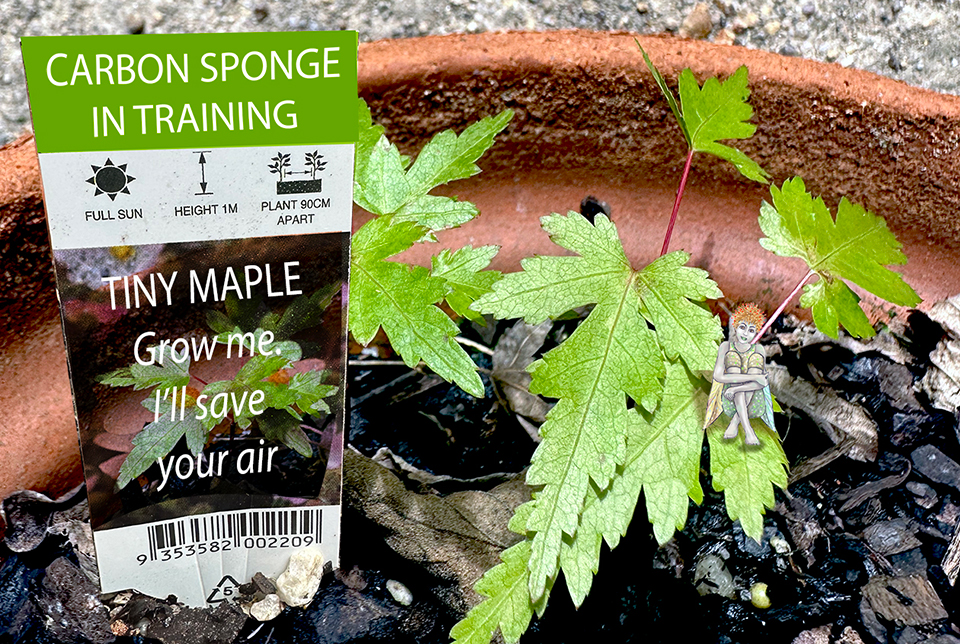
Which brings me to my own tiny corner of the Eighth Continent: our backyard maple.
Every spring it drops a generation of winged seeds. Ten or so sprout and I transplant them into pots, ready for anyone prepared to nurture them into a fully grown tree.
On average, dependant on species, a mature tree can absorb around 20–25 kg of CO₂ a year.
If all ten of my seedlings reach adulthood, they could draw down around 200–250 kg of CO₂ each a year.
That’s no mean feat for ten tiny maples. Not enough to solve climate change, sure. But multiply that across millions of gardens, streets, farms and forests, and the number has a more powerful impact.
We need massive global efforts to restore and protect forests. We also need the quiet, local work of tree-tenders: the people who water saplings, advocate for street trees, or simply refuse to let a seedling die in its pot.
Because every living tree is one small, green refusal to let the Eighth Continent burn.
MIN SAYS . . .
 Lisa Leong on writing and wonderIn SHARE
 Sandy McDonaldThe Eighth Continent is burning!In GET DIRTY
 Support beesIn LOBBY
 Lumin tears and human technologyIn DIG, SHARE
 Powerful owls and megowlsIn ACT, DIG
MIN’S IMAGES


-

- butterfly on mushroom in the forest, magic picture macro photo, seasonal landscape spring in the park


Publishing update
MIN BARKLIN and the SILVER RADIANTS will be published on 30 November, 2025, at a launch in Melbourne.
If you are interested in attending the launch, please click the QR code to register for free.